Sunday, November 19, 2023

MKBU Youth Festival 2023 Highlights

 Manbhavan Yuvak Mahotsav- 2023

Maharaja Krishnakumarsinhji Bhavnagar University

This blog is based on the Highlights of Youth Festival 2023 organised by Maharaja Krishnakumarsinhji Bhavngar University from November 2nd to 5th 2023. In this blog I  am going to share my experience of the Youth Festival and also going to provide an outline of various events. Stick around to get a glimpse of highlights.

Click here to visit my reflective blog of Youth Festival 


Maharaja Krishnakumarsinhji Bhavnagar University organised its 31st Inter College Youth Festival from 2nd to 5th November 2023 under the title 

"Manbhavan Yuvak Mahotsav"

which means something mindfulness, which is liked by our mind and soul.

This time it was hosted by Physical Education Department of the University. The central theme of this youth festival was 

"NariShakti Vandana"

which is inspired and attributed to recently passed NariShakti Vandana bill in Parliament.

     Throughout the Youth Festival women from vatious fields were felicitated for their work and good to see that the chief guests of both Inauguration as well as Valedictory were women. And it was heartening  to see that among 1171 participants, 721 participants were girls, which is around 62% of participation, embodying the true essence of Narishakti Vandana. MK Bhavnagar University has been the first university who has celebrates the whole Youth Festival Under the theme of Nari Shakti Vandana. 


This Festival Featured a total of 32 competitions organised under five sections, including literature, Music, Fine Arts, Dance and Theatre, each with a specific name,

- "मनभावन शब्दम" - English Department


- "मनभावन स्वरम" - New Court hall


- "मनभावन नर्तम" - Amphitheatre


- "मनभावन नाट्यम" - Atal Auditorium


- "मनभावन रंगम" - External Department


The entire Youth Festival was meticulously organized, and to facilitate transportation to the venue, three auto-rickshaws were also made available.

This time another initiative was taken and that is the creation of the theme song. This song is written by Prof. Himal Pandya and composed by Shri Chintan Pandya I am attaching that song here from which you can get the highlights of the youth festival as well.


       Another commendable aspect of this Youth Festival is that all the events were successfully live-streamed on the official YouTube Channel of the University. This provided an opportunity for many to virtually attend the event. I'll be including videos of various events as I write about them.

         As is the tradition every year, the Youth Festival kicked off with Kalayatra on November 2nd. The route for this procession was from Samaldas Arts College to Central Salt to Atabhai Chowk to Rupani Circle to Sardarnagar to Swaminarayan Gurukul, concluding at J. K. Sarvaiya Group of Colleges.


      Aligned with the festival's theme, most of the tableaux in the Kalayatra showcased the theme of "Nari Shakti Vandana" — a celebration and tribute to the power of women. Apart from this, Chandrayan was also at the center. 


Nari Shakti Vandana

નવ દુર્ગા રૂપે સાંપ્રત નારીને વંદન 

न स्त्रीरत्नसम रत्नम । 


वेद से वेग... भारत सर्वश्रेष्ठ


Chandrayan 

Nari Shakti Vandana


Oppression to Freedom:

નારી વંદના 


મોબાઈલ ની માયાજાળમાં માનવી 

Humans in the trap of Mobile


Click here to read more about the themes of Kalayatra.

Here I am attaching the video of Kalayatra:


Opening Ceremony/Inauguration Function:

        The opening ceremony took place on the 3rd of November. Dignitaries gracing the inauguration ceremony included Dr. Ami Upadhyay, the first female Vice-Chancellor of Dr. Babasaheb Ambedkar Open University and an alumna of our university, Yuvaraj Jayveer Rajsinh - the Prince of Bhavnagar, Bhartiben Shiyal, renowned folk singer Sagardan Gadhavi, Dr. Dilipsinh Gohil - the Head of Physical Education at the University and the In-Charge Registrar of the university, and Dr. Girishbhai Patel.


During the opening ceremony, some notable points were raised by the chief guests, which I'd like to share. In her address, Dr. Ami Upadhyay referred to women as synonymous with Shakti (power) and emphasized that

पराक्रम का मातृत्व भले ही पुरुष के पास हो ,

पर मातृत्व का पराक्रम तो स्त्री कर पास ही रहेगा ।

She also delved into the topic of the National Education Policy (NEP) 2020, highlighting that the essence of education lies in kindling and nurturing the inherent capabilities in individuals. The Youth Festival, being a platform for students to showcase and develop their talents, holds significant importance in this regard.

Sagardan Gadhavi added a touch of cheerfulness to the atmosphere with his folk song performance.


        This year, I took part in two events - Rangoli and the Elocution competition. Fortunately, both events were scheduled for the same day, the 4th of November. While I was able to attend events on the 3rd and 5th, unfortunately, I couldn't make it to the events on the 4th. The silver lining, however, was that all the events were live-streamed, and the recordings are also available on the University's YouTube Channel. This allowed me to catch up on them later.

     I made an effort to attend most of the events, aiming to gain something valuable and learn meaningful insights. Given my focus on language and literature in my studies, I observed that all the fields covered in the Youth Festival, in one way or another, share a connection with literature. This connection extends to both contemporary and ancient times, providing a pathway to explore new ideas. 

This is the very reason why Barad sir emphatically says us to attend all the events. Moreover, it is mandatory for us to attend all the events, as we have to craft a comprehensive blog, applying various literary theores and terms to each events. This practice allows us to scrutinize the presentation of both new and current ideas, cultivating a deeper understanding of their representation. The Festival demonstrated a harmonious blend of novelty and familiar elements, running parallel which contributes to a rich and diverse experience. 

    The festival presented a mix of novelty and the recurrence of familiar elements, running in parallel. This juxtaposition allowed for a rich and diverse experience, contributing to the overall tapestry of the festival.

This year, 32 events/competitions were organized across five sections. Let's delve into the highlights of each event.

Literary Events:

This includes Elocution, Quiz, Essay writing, Poetry writing and recitation competitions.

1. Elocution Competition:

In elocution competition, new subjects were brought including Artificial intelligence and Chadrayan.


Subjects:

1. Artificial Intelligence: How Challenging આર્ટિફિશિયલ ઇન્ટેલિજન્સ: કેટલું પડકારજનક? 
2. यत्र नार्यास्तु पूज्यंते 

3. Let's reduce old age homes ચાલો વૃધ્ધાશ્રમ ઘટાડીએ

4. Environment and Human Being: Two Sides of the same coin પર્યાવરણ અને માનવ: એક સિક્કાની બે બાજુ

5. Global Terrorism: Implications and Solutions વૈશ્વિક આતંકવાદ: અસરો અને ઉકેલો 

6. बुलंद भारत की बुलंद तसवीर  

I participated in Elocution competition and selected the very emerging topic 'Artificial Intelligence'.

2. Essay Writing:

Subjects:

1. India's Space Odyssey -ભારતની અવકાશી હરણફળ Benefits of India's Agricultural Opportunities
2. From Kitchen to Cabinet - Woman, Don't give up- કિચનથી કેબિનેટ - નારી તુ ના હરણી  
3. Are Wars Inevitable?- યુદ્ધો અનિવાર ખરા?
4. The importance of Value based Education- મૂળનિષ્ઠ શિક્ષણની આગત્યતા
5. Plastic Pollution: Problems and Solutions- પ્લાસ્ટિક પ્રદૂષણ: સમસ્યા અને ઉપાયો  

3. Poetry Writing and Recitation:


Subjects:

1. ઉમ્મીદ 2. સ્મરણની કેડીએ 3. જે કર જુલાવે પારણું 4. मेरी माटी मेरा देश 5. બાળપણ

4. Quiz:


In a quiz competition, there are usually two rounds: the first is a written round, and the second is an oral round. The questions cover a range of topics, including History, Literature, and current events. Participants are tested on their knowledge in these areas to determine the winners.


Musical Events:

A total of 11 competitions are held in the music department. Including

Bhajan

1. સાચા રે સંતો ની માથે 
2. વીજળીને ચમકારે મોતીડા પરોવો પાનબાઈ
3. પૃથ્વીના માનવી
4. કર્મનો સંગાથી રાણા મારું કોઈ નથી
5. મને જ્યાં ગમે છે ત્યાં હરું છું ફરું છું
6/ મોહે સુની સુની આવત હાંસી

Sugam Git

1. "પાનેતર પેહરાવો, કંકુ છાંટીને." 2. "આપણા જીવતરની આપણી જ વાતોમા."
3. ઠોકરની સાથે લગતાં જો નામ લેવાય છે ઈશ્વરનું."
4. ઠોકરની સાથે નામ તુજ લેવાય છે ઈશ્વર 5. "કુંચી આપો બૈજી." 6. "કૃષ્ણ તારી બંસરી વહાલી લાગે મને."

Indian Group Song


For the Indian Group Song, a medley of multiple songs were presented. It includes 3 to 5 songs. The initial segment showcased patriotic songs, featuring the folk songs.

1. हिन्द के बहादूरों ये वक्त की पुकार है  

2. પ્રાણથી પ્યારો  ભારત દેશ વિશાળ 

3. सारे जहा से अच्छा 

4. यू समय की रेट पे छोड़े चलो निशान 


1. જુલણ વહાલી વાગી 

2. કોઈ કે ઓધવ આવે કોઈ કે માધવ આવે  

3. જુલણ મોરલી વાગી રે 

4. હોથલ પદમણી 


Classical Singing,  Western Solo song and Western group song:


Folk song

1. કાન શેરી રમો

2. તલગાજલ છલગાજલ જામનના પાણી

3. કાળી કાળી વાદલી માં જબૂકે વિજળી

4. મણિયારો તે હાલું હાલું થાય રે વિયો

5. હાજી કસમ તારી વિજળી રે

6. સોના વાટકડી રે

7.વાદલડી વરસી રે સરોવર છલી વાલ્યા.


Classical Music- Vocal


Classical Music- Rhythm


Folk Orchestra

This time, there were only three folk orchestra performances. I truly appreciate events that feature instruments such as Dhol, Nagara, Manjira, Khanjri, Tabla, Shankh, Matli, Ghunghru, Ghant, Shehnai, Flute, Dandiya, Daklu, Sitar, Tamburo, Dholki, Kartal, Bin, etc.

દુહા-છંદ 


Dance:

Folk Dance


The folk dance performances were amazing, and each person showed off our diverse culture. They performed different types of dances like Adivasi Ras, Mishra Ras, Prachin Garbo, Arvachin Garbo, Tippni, Hudo, Timli, and more. These dances need a lot of energy, and the dancers wore pretty traditional outfits. The music was lively, with a group singing along, making it even more exciting. Folk dance is always the highlight of the youth festival, making it fun and lively for everyone.

Classical Dance


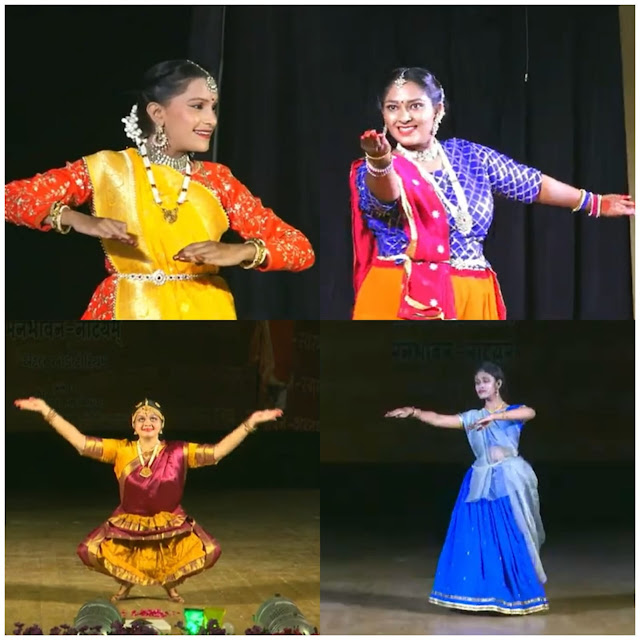
Classical dance embodies the essence of our culture, making it truly mesmerizing to witness such performances. In classical dance, specific attire is worn, and facial expressions play a significant role.

Theatre Events:
Total five theatrical events were organised including Mimicry, Skit, One act play, Mono Acting and Mime.

Mimicry
Mimicry poses a formidable challenge, demanding participants to skillfully replicate an array of sounds, ranging from trains, bullets, helicopters, shankhs, animals, doors, birds, actors, soda bottles, Daklas, bombs, heartbeats, and more. Some contestants elevate their performances by introducing rhyming elements, adding an extra layer of creativity to their renditions.


Skit


One Act Play


Mono Acting


Mime


Fine Arts events:
Fine Arts competitions includes On the Spot painting, Poster making, Rangoli, Paper Collage, Mahendi, Cartooning, Clay Modelling, Installation and On the spot photography. Except rangoli, subjects were given to all the fine arts events. because rangoli competition follows the traditional rule whereas all others are much about the portrayal of the contemporary happenings.

On the Spot Painting
Subjects:
ઊત્સવોની ઉજવણી
નારી શક્તિ વંદના


Poster Making
Subjects:
વૃદ્ધોની સેવા
પાણી બચાવો
કન્યા શિક્ષણ


Paper Collage
Subjects:
Fish Tank
Flower Pot
Rainy Season


Cartooning

Subjects:
મોંઘવારી 
ચુંટણી 
ગાંધીજી અને જનતા


Cartooning is different from regular painting. It's all about having a good sense of humor. The main thing in a cartoon is making a clever joke, and the big, exaggerated characters help to highlight certain things, often in a funny way. In a way it's a kind of satire.

Clay Modelling


Installation


Subjects:
નારી શક્તિ
સુરક્ષા 
મજૂર 
ચિકિત્સા (આયુર્વેદના સંદર્ભમાં )


On the Spot Photography
Subjects:
યુથ ફેસ્ટિવલ 2023
આજની નારી કુદરતની સંગાથે

Rangoli:
In the Rangoli competition, there are no specific subjects given because it's all about tradition. Rangolis have been and continue to be created on special occasions. They are designed to look the same from all sides and should not include any specific pictures but instead follow traditional patterns. The focus is on preserving and showcasing the cultural and traditional aspects of Rangoli art.


Valedictory Function:

The closing ceremony of the Youth Festival is a source of great joy for both students and institutions, as it marks the culmination of participants' hard work. This formal event took place on November 5th, preceding the result announcement. The chief guests for this special occasion were Sejalben Pandya, Shri Nirenbhai Bhatt—a renowned writer, and Shri Meran Gadhavi— a famous folk singer. In their speech, the chief guests talked about their time of youth festival and enliven those precious moments with us.


Swami Sahjanand College of Commerce and Management emerged as the overall champions, securing the general championship, while KPES College claimed the position of runners-up. Congratulations to both institutions for their outstanding performances in the Youth Festival!


I participated in Rangoli competition for the first time and have secured the second rank in it.


This year, we, the students of the Department of English at MKBU, took part in a total of 18 events. I was fortunate to secure the second rank in Rangoli, while Dhatri earned the second rank in Cartooning.


I also participated in the Elocution Competition, and although I didn't secure a rank, I'm pleased that my performance matched my expectations. Congratulations to all the participants as we have learned that active participation is essential, regardless of the rank.

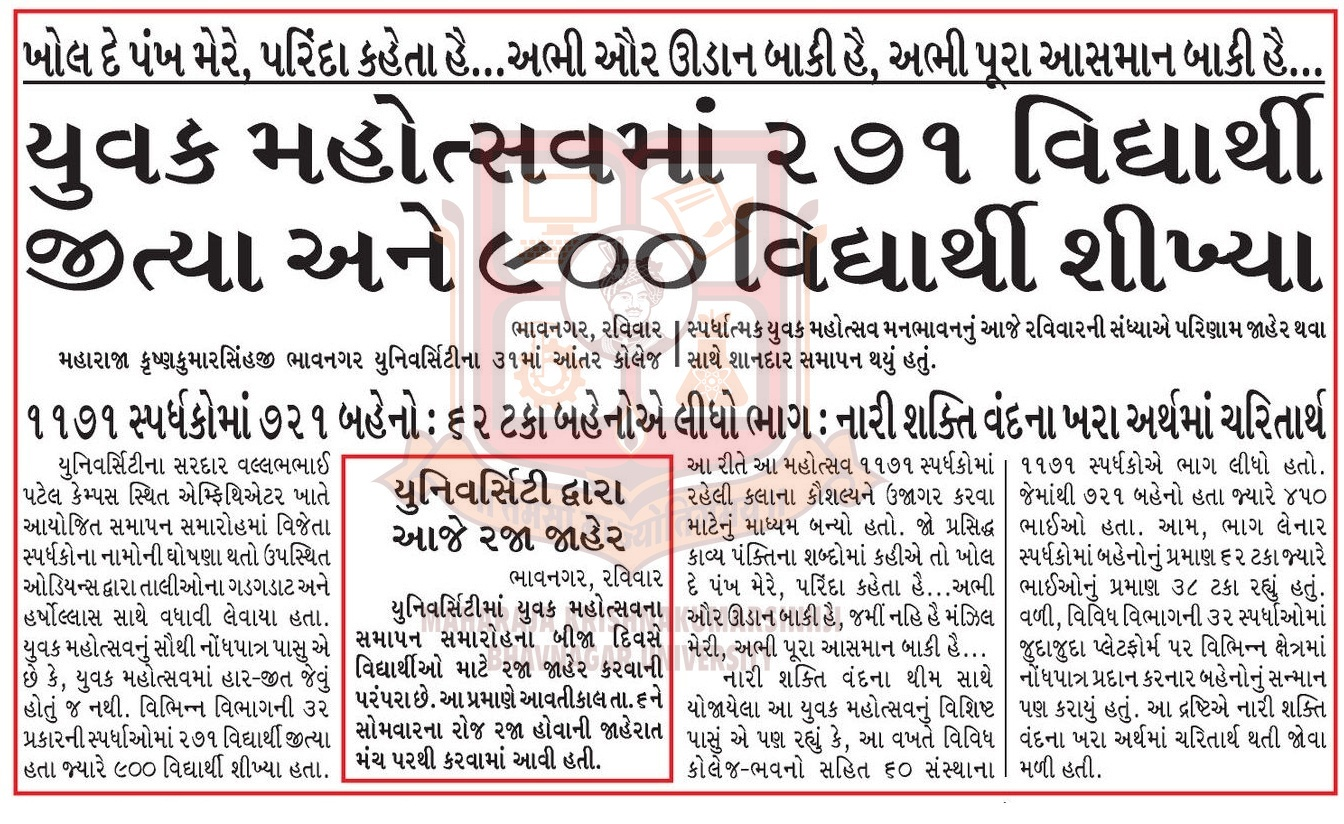
It's noteworthy that out of 1171 participants, 271 students achieved a rank, while 900 students gained valuable learning experiences. This highlights the importance of active involvement and the knowledge gained beyond the rankings. This was also reflected in the news paper.

Congratulations to everyone for the fantastic achievement! Throughout the Youth Festival, we've delved into various experiences, attended numerous events, and connected the dots with our learning journey.
Kudos to all the participants! What matters most is our active participation and the valuable experiences gained, regardless of whether we secured something tangible.
Thank you for visiting!

{Words: 2227
Images: 83
Videos: 22}

Monday, October 30, 2023

Objectives of Presentations and Bloom's Taxonomy


      The Department of English- Maharaja Krishnakumarsinhji Bhavnagar University is widely recognized for its innovative approaches to teaching and learning. As an integral part of our academic journey, the students in the Department of English engage in presentations. Each year, Dilip Barad sir orchestrates these presentations in a distinctive and enriching manner. These presentations typically encompass the use of PowerPoint presentations, interactive question-and-answer sessions, and live streaming on platforms like YouTube and Facebook.

       The motivation behind live streaming these presentations is multifaceted. Firstly, it ensures that our work is archived, allowing us and others to access it at any time. Moreover, it provides an opportunity for a wider audience to witness and appreciate our efforts.

      One of the most significant advantages of this presentation method is the opportunity for self-assessment and improvement. Personally, I take advantage of this by reviewing my presentation videos to identify areas where I may have made mistakes or areas for improvement. This process enables me to continuously refine my presentation skills and enhance my performance.

      The primary objective of these live presentations is to document our progress. Within this presentation session, we employ two types of evaluation to gauge our growth and development.


In the context of these presentation sessions, there are two distinct methods of evaluation:

1. Teacher's Evaluation: Dilip Barad sir assesses the presentations based on a rubric that covers aspects like content, verbal skills, content quality, non-verbal skills, and research and research writing.

2. Peer and Self-Evaluation: Students also receive feedback from their peers as part of the evaluation process.

Every day we can check how we are being evaluated by sir and our classmates. Self-evaluation is also there where we have to give a score to ourselves, which is included under Peer and Self-Evaluation.

The development of our skills through these presentations occurs in three distinct ways:
      1. Subject
      2. Presentation Skills
      3. Digital Skills

1. Subject:
        In this first aspect, the goal is to enhance our understanding of the subject matter. By connecting various concepts and ideas, we expand our knowledge and develop new ways of thinking. To illustrate this, Barad sir shared Bloom's Taxonomy or Pyramid, which classifies thinkers into "LOT" (Low Order Thinkers) at the bottom and "HOT" (High Order Thinkers) at the top. We also aim to improve our articulation and language proficiency, including the formulation of questions for the subsequent question-and-answer session.


2. Presentation Skills:
         This involves enhancing our ability to create visually appealing and effective presentations. It contains aspects such as graphic design, color schemes, maintaining a consistent theme between the presentation topic and slides, and selecting appropriate fonts. Moreover, it extends to our delivery skills during the presentation, which tests both our verbal and non-verbal communication abilities. Many of us have overcome stage fright as a result of these presentation sessions, and we have noticed a remarkable improvement in the effectiveness of our presentations over the course of these three presentation seasons.


3. Digital Skills: 
        In the 21st century, digital literacy is of paramount importance. Through these presentations, we become more familiar with technology and its practical applications in our academic pursuits. We all use mobile phones, but learning how to harness them effectively for our studies is essential. Our digital skilling encompasses tasks such as handling mobile devices and laptops, live streaming via platforms like Stream Yard, and re-uploading our presentations to our personal YouTube channels. Additionally, Web Quest has always been difficult. There are so many sites available for study but to find authentic sources, it is very much important to learn how to search and what to search. Learning how to search for and utilize high-quality materials and proper citation techniques is integral to developing our research writing skills.

These are some of the key takeaways from my experiences in our initial presentation season.


Bloom's taxonomy plays a critical role in our presentations, falling under the cognitive domain of teaching and instructional objectives. It's structured into six stages:

      1. Knowledge
      2. Comprehension
      3. Application
      4. Analysis
      5. Synthesis
      6. Evaluation


1. Remember - This stage involves recognizing and recalling facts, which is something we all did during our childhood and is fundamental to learning.

2. Understand - It's not enough to merely remember facts; we must also grasp the meaning and significance behind these facts.

3. Apply - Taking that understanding a step further, we must learn to apply these facts, rules, concepts, and ideas in practical and meaningful ways.

4. Analyze - The ability to break down information into its component parts is the next level of cognitive development. This helps us see the intricate details within a broader context.

5. Evaluate - Beyond analysis, the capacity to judge the value of information and ideas becomes paramount. This stage involves critical thinking and discernment.

6. Create - The highest level of Bloom's taxonomy is the act of combining these parts to form a new whole, fostering the development of new ideas and innovative thinking.

       Education is not confined to the mere accumulation of facts and ideas. Instead, it encompasses our capacity to analyze, evaluate, and apply these ideas in various contexts, including history and cultural aspects. True education lies in our ability to think critically and act upon our knowledge. In this context, the final stage, 'Create,' does not refer exclusively to artistic expression like poetry or art, but rather to the synthesis of diverse elements to generate new, innovative ideas.

The purpose of our presentations aligns with the same goal. As students in the Department of English, we select topics, seek historical connections, and then apply these insights to contemporary issues.

Another significant element is the question-and-answer session. This practice enhances our ability to delve deeper into our chosen topics. This develops a habit to look deep into the topic we have selected, how aware we are in the areas related the topic.

During my first and second semesters, I faced challenges in effectively conveying my ideas in most of the presentations. However, I'm delighted to share that this time, I scored 100% in every presentation. I believe that this success stems from my comprehensive approach. I diligently considered past, present, and future aspects, along with their implications and advantages. I do acknowledge that there is still room for improvement, and I aim to make my future presentations even more engaging and impactful.

Happy to share that during this presentation season, I succeeded in clearly articulating my ideas, and I am pleased with my performance. I am optimistic that in the upcoming and final presentation, I will excel even further.

       Thank you Barad sir for always introducing us to new ways of learning and filling that enthusiasm in us to work.

Thanks for visiting...

Thursday, October 26, 2023

Presentation: 15 Paper no. 205

CANCEL CULTURE


This is my presentation on Paper no. 210: Cultural Studies


Here is the video recording of my presentation.

Thanks for visiting...

Joseph Andrews by Henry Fielding – Plot

  Joseph Andrews by Henry Fielding – Plot  Introduction Joseph Andrews was written by Henry Fielding and published in 1742 . Its complete ...