Wednesday, July 13, 2022

Personal presentation

                 This blog is based on the presentation given by me at the Department of English, on the occasion of Guru Purnima in Daily Assembly. Many students presented their views through poetry, thoughts, personal presentation, monologue and song.  


                  This was also my first presentation there. For that I prepared PPT which is based on learning from and with social media and technology. I have learnt how to use technology as learning tool in 21st century by the department of English when I was not part of the department by the help of YouTube videos, blogs and other platforms shared by Barad sir and our senior students. So it was very important opportunity for me to present something which I have already learnt from here. 


                I'm feeling very grateful to share this on the occasion of Guru Purnima, especially in the presence of Baradsir.


Thanks for visiting


Saturday, June 25, 2022

Origin of the Language


       Before looking at to origin and development of the English Language over the past fifteen hundred years or more, we have to have insight about the elementary fact concerning language in general. 

1. Spoken, not Written :-   

            The first thing is that language is basicaly Spoken, not Written. By the writing from the thoughts and speech, we are now be able to acquainted about the ways of life and the modes of thought of our ancestors. Without this we would be far away from the greatness of our past, and it would be quite impossible for us to study it in a present time. We can only get the knowledge about the language and its structur by studying contemporary written documents, like Julius Caesar or King Alfred the great, which is survived. It will be quite advantageous for future generation to investigate the language of our age because of the invention of Gramophone and Tap-recorder. 

             Nowadays, though the language is in primitive sense, something that is Oral; but, because of the fountain to relying on written documentary for linguistic research, reading and writing covered so large place in our daily lives. So it had an influence on the development of language.   

2. Evolutionary, not Static:-

               In any thing, evolution is part of everyone's life. If we draw our attention towards the writing of Chaucer and compare it with modern English, it will obviously differs from each other. If we look even further back to early Anglo-Saxon, we may find more difference. Though the evolutionary factor is a wheels and generally recognised, it is assume that the language now become more or less fixed and set. There will be same as today to two centuries and more. The changes are still going on in pronunciation, in grammar, and in the actual significant attached to words, anyone who has reached middle age can prove this from his own experience. A few reforms in grammar and spellings are creeping in, because of natural causes, American influence and partly through the attempt of BBC. If we look at back in the history of language, we can see rapid process of change in the speech. Saw that development in the history of language took place when the documentary evidence might be studied.

3. Language - differs man from animal:-
 
                   The language is the only factor which differs man from animal. Every rest of human being speaks some kind of language. The lower animals merely make typical noises to indicates such as fear, anger, sex, Joy, etc. Yet Pro. Lloyd James as yours that many animals have the necessary speech organs. If they develop it as man did, they would probably have developed in similar direction. 
      
                  Today main are speaking the particular language that passed from the utterance of mere instinctive noise. It's all because of the development of human mind and personality. The definite origin of the language is still a matter of dispute, many learn need person have written on the subject without sufficient measure of agreement. At present 4 chief theories hold the field. 

1. The Bow-wow theory:-

                    This theory holds the attempt of main to imitate some characteristic sound of the creature or object.  The young child adopt the same method reproducing behaviour of adult. This theory points out the same. Dog is the animal that says Bow-wow, man distinguish a dog from other animal in its bark. So it is called Bow-wow theory. Some theorists believe this as the beginning of language. In a word snake, we can hear the hissing sound, in wind there is an imitation of whistling of the gust. In many words of recent college which denote sound, anomatopoeic element has played a conspicuous part.

2. Ding-dong theory:-

               This theory is associated with German scholar and physiologist Maxmuller.

        According to this theory, beginnings of language are found in rhythm, from a very primitive stage of its existence. The theory also based on imitation rather than of sound. 

Observing a certain rhythm in Berlin of the stream of trees in the wind, man ding-donged.

      The theory connect with the same impulse which give rise to the savage war dance, the medieval ballads and the sea chanties.

3. The Pooh-pooh theory:-

                  The theory which trace is all forms of speech utterance back to emotional interjections evoked by pain, surprise, pleasure, wonder, etc. This has become known as Pooh-pooh theory. At first Pooh-pooh is just an exclamation, implication or disgust. Through being frequently used with this implication it acquires a meaning, from this root formed the verb to Pooh-pooh, which take definite place in the spoken, if not in the literary language. This principle, one school of theorists would contend, underlies the origin of all languages.

4. Gesture theory:-

               This theory is advanced by Wilhelm Wundt and later represented by Sir Richard Paget in his book, "Human speech", called as gesture theory.

Tuesday, May 24, 2022

Peacock as a satirist at the point of view of R. J. Rees


Thomas Love Peacock:-


             Thomas Love Peacock grew up in the air of romantic revival. There were three things in the Romantic view of life which Peacock thought absurd when carried to extremes:

2. Found particularly in Coleridge and Wordsworth, which presents vague philosophical idea of pantheism. It describes that God and Nature are the same. Poets and thinkers draw their inspiration from the Nature.

2. An exaggerated love of the medieval and the supernatural of Mrs. Radcliffe and Scott.

3. Peacock noticed the passion for "reforming the world" in his contemporaries Shelley, Godwin, Bentham and J. S. Mill.

         Peacock was old-fashioned and reactionary in his views. He often make fun of the excesses of reformers.

         Peacock wrote his satire in the form of novels; but his novels are very different from what is usually understood by the word.

The Short Story - General introduction


        Short story generally means ''A story which is short''. Short story is a form or genre having rules its own. One of the most successful short story writer of our time, H. E. Bates wrote,

The basis of almost every argument or conclusion I can make the axiom that short story  can  be anything that the author decides it shall be. 

          The shortest of short stories may be no more than a page or two in length; some short stories run to over a hundred pages like, D. H. Lawernce's St Mawr for instance. It's too impossible to draw a line between the long short story and the short novel. It is sometimes go under the name of 'Novella' for the doubtful examples. The Novella is a different from the genuine short novel in its smaller number of characters, its less varied setting and its simple plot. Let's look at some of the examples of this kind of doubtful writing;

  • Lawrence's tales; like The captain's doll and The virgin and the gipsy
  • Henry James's The turn of the screw 
  • Maugham's Rain                                                                                                                                           
H. G. Wells himself was a master of the short story teller's art, says that,

A short story is, or should be a simple thing; it aims at producing one single vivid effect; it has seize the attention at the outset, and never relaxing, get it together the more and more until the climates it reached. The limits of the human capacity to attend closely therefore set limit to it; it must explode and finish before interruption occurs or fatigue sets in.

      According to critics and historian, in the short story there is something new - a product of the 19th century and the first half of the twentieth.


Saturday, May 21, 2022

Reality and sincerity by F. R. Leavis


★ Introduction:-

                   Literary criticism occupies its own position along with literary creations. I. A. Richards, Leavis, Eliot, and many critics have established "New criticism". F. R. Leavis has the lasting effect on English literary criticism. His ideas are welcomed widely on practical criticism. In the present essay he has proved his excellence as a critic. The essay"Reality and Sincerity" is written by F. R. Leavis. According to him this essay came into existence to established an order of preference of three poems.


★  About critic:-

Born:- 14 July, 1895

Died:- 14 April, 1978

        Frank Raymond Leavis was an English literary critic of the early to made 20th century, who championed seriousness and moral depth in literature and criticized what considered the amateur belletrism of his time.


★ Major Arguments:-

          According to F. R. leavis, this is came into existence by the comparison of three poems, to established an order of reference, which poem should come lowest in order of preference, which are,

  1. Alexander Smith's "Barbara"
  2. Emily Bronte's "Cold in the Earth"
  3. Thomas Hardy's "After a Journey"
            Leavis has given statement that two poems are easy to understand and analyse, but Barbara is slide difficult. The purpose behind this comparison is to understand "why some poems are better than other".

  In the beginning he describes about Alexander Smith's poem Barbara,
 
★Alexander Smith's Barbara is about irrepable loss. It deals with the sufferings of an unbearable sorrow. It is basically cheap in nature, extremely vague and on realistic in nature. Therefore Barbara does not need any kind of analysis. Leavis's criticism of Smith's poem has nothing to do with tactical reading through the verse, it looks very personal. Each line is a memory, there is almost a picture in each line. Smith decides the words as he himself sharing his thought with Barbara. He is talking to her and he knows what to say so that she will understand him. 
 
         In the second part, Leavis presents Emily Bronte's is poem 'Cold in the Earth'. In an earlier book Leavis has called this poem as the finest poem of the 90th century, but in this letter essay he describe this poem as a failure. 

★The emotional sweep of the movement, the declamatory plangency of Cold in the Earth might seem to be represent dangerous temptation; but in responding to the effect of passionate in intensity we register what impress us as a controlling strength. The poem is read as plangent which suggest that there is something dangerous in it. Instanza 7 he describes that,
Then did I check the tears of useless passion.
           "Cold in the Earth'', in its strong plangency might reasonable be judged to be notable movement. However  if we go on to judge Hardy's After a Journey is a much final thing to be placed as a poetic achievement. According to leavis, those who confidently place Cold in the Earth above Barbara, do as a rule, judge after a journey superior to Cold in the Earth.
     
         Thomas Hardy was well known both as novelist and as a poet. His wife died in November 1912 after a short and painful illness. The shock of his wife's death filled Hardy with feeling of remorse and regret and that he produced a series of poems that are very powerful.

          The poem is a healing poem with seems to referbic to the care of his life. F. R. Leavis describes it as intimate or self communing. He describes it in a line,
Where you will next be there is no knowing.

           We can call itself communing, because when Hardy addresses the ghost, he is still addressing himself. It is easily recognised that the distinct quality of idioms and diction with the intimacy of tone achieves some striking accuracy and naturality.
 
         Hardy's poem, put side by side with Emily Bronte's is seem to have a great advantage in reality. If we can find a way that to say that hard dis poem has an advantage in reality is to say that it represents a profound and completer sincerity.
  
          It is like we are listening to Hardy is talking to himself somewhere inside our mind. He describes his wife in poem,
Nut coloured hair, and grey eyes and Rose flash.
         If we compare it with other two poems, there is absence of positive tone which Leavis describes as a having a great advantage and reality. The first word in the poem "Hereto" make Sun immediate effect of balance. Leavis describe the poem as a journey back through the time but actually we cannot go back to the time. Memory can recall his wife but her presence in the poem makes her absence. There is a detailed analysis of the line,
But all's closed now, despite time's division.
           The line makes this point clear; this is the statement that says, everything is closed despite time's standing. There is balance all over and the suffering of loss. He also gives an example of the first line,
Hereto I came to view a voiceless ghost.
          When we consider "view" it has been challenged. But we cannot judge 'view' until we have realised what is the nature of the ghost. Thomas Hardy is expressing the reality of rememberence but he also says that,
I am just the same.

         The point in this thread is to try to understand how we can recognise truth of the poem, or what makes a good piece of poetry, what is it about poetry that makes people want to write it. While Emily Bronte's poem "Cold in the Earth" is a striking poem, but when we go back to it from Hardy's, we may come to judgement that she is dramatising herself in a situation such as she has dearly not known in actual experience. While Hardy presents specific fact and concentrate circumstances.
  
        At the end of the essay, we come to know that Alexander Smith's "Barbara" comes lowest in order of preference.

★ Conclusion:-
     
           To sum up, we can say that above all F. R. Leavis, comparing piece of work "Cold in the Earth" and "After a Journey" on the base of reality and sincerity, come to conclusion that Hardy's "After a Journey" is more effective poem. Highlights the element of reality and sincerity more than the poem of Emily Bronte.

Saturday, March 5, 2022

Intentional fallacy

 Introduction:-

                The claim of author's intention upon critic's judgement has been challenged in a number of recent discussions. W. K. Wimsatt and M. C. Beardsley, in his essay "Intentional fallacy" raised the issue of it. The term used in 20th century literary criticism to describe the problem inherent in trying to judge a work of art by assuming the intent or purpose of the artist who created it. The Intentional fallacy was first published in 1946 and later published in The Verbal Icon in 1953.      


About the Critic:- 

            William Kurtz Wimsatt (1907-1975) and Monroe Curtis Beardsley (1915-1985) are best known for their co-authorship of "The Intentional Fallacy" and "The Affective Fallacy". Both the essays articulate what have come to be considered the fundamental tenets of the American New Criticism. In the first essay they describe the problem to judge a work of art by assuming the intent or purpose of artist, who created it. In the second one, they refer to the supposed error of judging or evaluating a text on the basis of its emotional effects on a reader.

General introduction of an essay:-

           "Intention" in literary work simply means "What he intended". In order to judge poet's performance we must know what he intended. Intention is design or plan in the author's mind or what made him write. Out of these, Wimsatt and Beardsley make strong arguments about the problem of author's intention. 

          A poem does not come into existence by an accident. As professor Stoll has remarked,

A poem comes out from a head, not out of a hat.

         Through the design or intention as a standard of poem, a critic should not judge the worth of the poet's performance. They argue that the problem with intention is that it requires private knowledge about the author. To know what the author intended, we have to learn contextual knowledge that exists outside of the work of art. This may be interesting for historians and definitely has its own value, but it is irrelevant when judging the work of art for itself. A poem can be only through it's meaning- since its medium is words - yet it is, in the sense that we have no excuse for inquiring what part is intended or meant.

A poem should not Mean but Be.

              Poetry succeds because all or most of what is said or implied is relevant; what is irrelevant has been excluded, like lump from pudding. In this sense, poetry differs from practical messages, which are successful if we correctly infer the intention.

          "A work of art should be judged not the realisation of meaning", we moved away from this idea during the period of Romanticism, which believed the author was some genius who needed to be understood in order to appreciate the work of art. It created a fixation on the idea of the "author".

          In reality, they argued, a poem does not have an author, it has a speaker. The real success of the poem depends on how the speaker conveys meaning. It doesn't matter, if we don't get what the author meant to say as long as we get what the speaker is speaking. For example, alluding to something in another country that we have no knowledge of, doesn't mean we should learn about that thing in advance to understand the poem; The illusion in itself should have a "suggestive power" that allows us to understand its significance without searching for its private knowledge - meaning.

Main Arguments:-

            The main argument on which essay is formulated rests upon the clash between romantic and modernist concept of literature. Romantics define it as "vehicle of personal expression" and modernist define it as "pure linguistic art". Wimsatt and Beardsley started by arguing that intentional Fallacy is a romantic phenomenon as it depends on expressionist aspects of poetry. They quote a rhetorician and philosophical critic Cassius Longinus who defines,

Sublimity is the echo of a great soul.

            Also, Goethe, a German poet, playwright, novelist and critic, focused upon author's intention in order to perform"Constructive criticism" of text and sets three questions: "What did author set out to do?" "What his plan reasonable and sensible?" and "How far did he succeeded in carrying it out?".

           Similarly, Benedetto Croce stressed upon gazing work of art as author gazed it while producing it. i.e. stressed on "author's gaze" or "author's intention". In short, he focuses on looking the text with author's eye. 

        These pre-modernist beliefs were debased by new criticism intentionalists like Wimsatt, who saw work of art as a "Verbal Icon" that means the text speaks, it has its own soul and author is not required to give direction to the way of the reading the text. 

            T. S. Eliot, in "Tradition and Individual Talent" argued that  the truthful criticism and sensetive appreciation of text is directed upon poetry, not poet. Critic's like C. S. Lewis and Tillyard also carry forward the same formulation in "The Personal Heresy". Oscar Wilde in "Picture of Dorain Gray" revealed the aim of art i.e. "relevant art" and "conceal artist" hense bestowing due importance and value to the text or art.


Dramatic speaker vs Author:-

         Furthering this argument, they tried to build a distinction between dramatic speaker and the author. Anti intentionalists claim that if poem is expression of personal emotions, then that emotions should not be confused with author's emotions, because they are emotions of "Dramatic speaker". Beardsley affirmed that lyrical poems of Wordsworth are representational and not performing one. So one should focus on speaker and not in Wordsworth, because linguistic work has quality of being "self - sufficient linguistic entity" and poem is "Verbal Icon" which belongs to public domain and not to the poet.


Conclusion:-

            To conclude, after the publication of "The Intentional Fallacy", poetic analysis was given more importance than biographical criticism focusing on internal evident. Intentional fallacy, a literary term asserts that the meaning intended by the author of a literary work is not the only, and perhaps not most important. The notion has become central to modern literary criticism and is an important part of what is known as the "New Criticism".


Thanks for visiting...

Friday, March 4, 2022

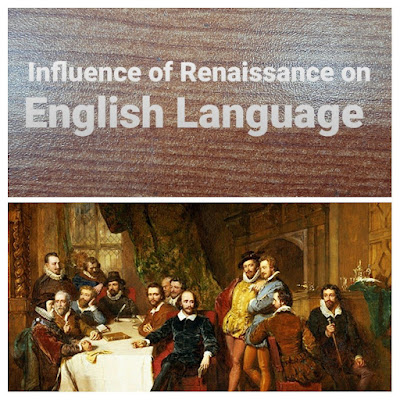
The Modern English Period (The Renaissance and after)


Introduction:-

            The final stage in the history of the development English language is the period of modern English from 1500 onwards. 1500 marks a similar turning point because of Renaissance. It alters the character of English Church and the establishment of Tudor dynasty which made England a nation in a real sense.

◘How the Renaissance had started?

         In 1453 Constantinople, the seat of European learning, fell to the Turk. The scholars fled to Western Europe, bringing with them as much of their libraries as they could manage to rescue and transport. They settled at first mainly in Germany and Italy and started the intellectual awakening of Europe which has come to be known as the Renaissance.

          The flood of the new learning reached England about the year 1500 and that it had a marked influence upon the language and literature. As to concern with language, development would have taken place without the impact of The Renaissance. But the new scholarship and all that is implied did produce new forces and add new words to the vocabulary.

           It was a classical Renaissance and mainly a latin one, which had chief effect upon our vocabulary. We can see many English words of Latin origin or from Latin roots. It existed in middle English via French. Latin had not entirely unknown to the clergy and To The monk. It had very large part of church service and used for a number of medieval religious treaties and had very little direct effect upon the native tongue. For example word like., Confession, honour, melody, etc.

         We also find new words direct from the Latin, and since the home of much of the new scholarship was Italy, Italian words also begin to make their appearance in English, especially in connection with music and the art.

        Though the main importance of Renaissance was primarily religious and political, it had its effect upon the language as well. The bitter religious controversies produced numerous words and gained permanent niche in the vocabulary.

         A very important outcome of the reformation was the various English translation of the Bible, the chief being Tyndale's in 1526, and more important, the authorised version in 1611.  Tyndale brought under a strong Protestant tradition and fought shy of anything which might be constructed to suggest the Roman Church or justify its claims.

           The translations of Bible has been a strong formative influence on the style of many eminent writer and played a definite part in shaping the literary language. It has provided us new words, which originated with the classical scholars, and adopted into spoken tongue and maintained in it. And secondly, it has provided new words which were early adopted into the spoken tongue and have remained in it ever since. The translators adopted a vocabulary which was predominantly native in character. The invention of printing was bound to have a far-reaching effect the development of the language. Three aspects of it is is noticed here.,

1. It tended to establish a standard language and discredit dialect. Each dialect had it on literature. Printing altered this and henceforth dialects board the brand of inferiority, and though they continued to be spoken they fell out of literary use.

2. It served to popularise and give currency to new coinages and newly introduced words.

3. It tended to fix spellings. The publication of Johnson's dictionary, what's the really decision factor but techstern managed to impose some kind of standardisation and to reduce the former chaos. But in doing this he was indirectly responsible for the differences between spelling and pronunciation. The spelling was more or less fixed by the end of 15th or the beginning of the sixteenth century, but the pronunciation has been constantly changing.

★ If we look at briefly towards these changes,we can observe some very vital points to take it into consideration while observing the influence of Renaissance upon the English language. Which are...

  • Renaissance scholarship
  • The religious controversies arising out of the reformation
  • The various translations of the Bible
  • The efflorescence of literature towards the end of the 16th century
  • The emergence of national consciousness
  • The discoveries of newlands by navigators
  • Opening of trade
  • The invention of printing
              All these factors combined need to make the language after 1500 English in a way that that of chaucer and his age had never been.

During Renaissance English language got many changes into four parts of language. Which are...
  1. Vocabulary
  2. Pronunciation
  3. Spelling
  4. Grammar
1. Vocabulary:-
                  During the English Renaissance some 10000 to 12000 words entered the English lexicon. Many of these words were borrowed directly from Latin, both in its classical and mediaeval forms. Renaissance give rise to a number of synonyms which make nice distinction in meaning especially in the case with adjectives. We shall find this words into groups of three, 1. A native root, 2. From French and 3. From Latin. Another feature of the English language which we owe to the Renaissance is our habit of using an adjective of classical derivation to correspond to an active noun. Ex.,

Word - adjective
Hand - Handy
Nasal - Nosey

              The commonwealth was followed in 1660 by the Restoration and with this came further influx of French words and phrases.

2. Pronunciation:-

               If we look at the pronunciation, we can observe that until the middle of 18th century there is the conflict between the native and the anglicised pronunciation of original words. Most of the changes in pronunciation noticed during the early modern period, which are not new, but it had already begin in the middle English period. The chief of them are.,

★  Short ā was lengthened before the consonants 's, f and th'.
Ex., Bath, father, rather, ask, task, flask, master, craft, etc.

★ Lengthening of short ā also took place, where the consonant 'l' become silent.
Ex., Palm, half, calf, calm, etc.

★ The long ā in some words became ēī due to the modification in the middle English period.
Ex., Cake, ale, dame, fame, etc.

★ The Anglo-Saxon and middle English long ā was being modified in long ī. 
Ex., Feet, seek, deep, heat, seat, beat, eat, field, believe, etc.

★ By the end of the 16th century the original ī became āī.
Ex., Fire, write, light, life, blind, wife, etc 

★ The middle English long ū had became the diphthong āū.
Ex., House, mouse, mouth, cow, etc.

3. Spelling:-

               Many changes took place in the spelling of English since the formation. Ex., 
★The words like music and comic are ending in -ic, earlier it was spelt with -ick.
★ Other changes in Spelling...

4. Grammar:-
                     The grammatical changes that came about in English during the early modern period are very few, though they are very important in the direction of greater simplification. For example,
  • The conjugational inflexions in plural verbs finally disappeared
  • The possessive adjective it's had come into general use by the end of the 17th century in the place of his for neuter.
  • Adding s in nouns was adopted as the method of forming the plural
  • The degree changes by the simple addition of the suffixes -er and -est to the positive degree.
Conclusion:-

                To conclude, it is clear that from being a complex, highly infected language, English had become a comparatively simple one. On the other hand the learning and scholasticism of the Renaissance tended to produce certain affectations of style and diction, and a certain artificiality becomes more marked as time goes on, between literary and spoken English.

International Conference on “Narrative Nuances: Text and Audio-Visuals"

  International Conference on “Narrative Nuances: Text and Audio-Visuals" I had the wonderful opportunity to be a part of the Internati...