This blog is written as a part of Ph.D Coursework including the Questions of Exercise from the First chapter, Introduction to the Handbook from the book The Handbook to Literary Research, edited by Delia da Sousa Correa and W.R. Owens ( edition 2010 by Routledge)
Q 1. Take the online tour of the Dewey Decimal Classification System on the OCLC
website (www.oclc.org/dewey/resources/tour), and complete the ‘test your knowledge of DDC’ section.
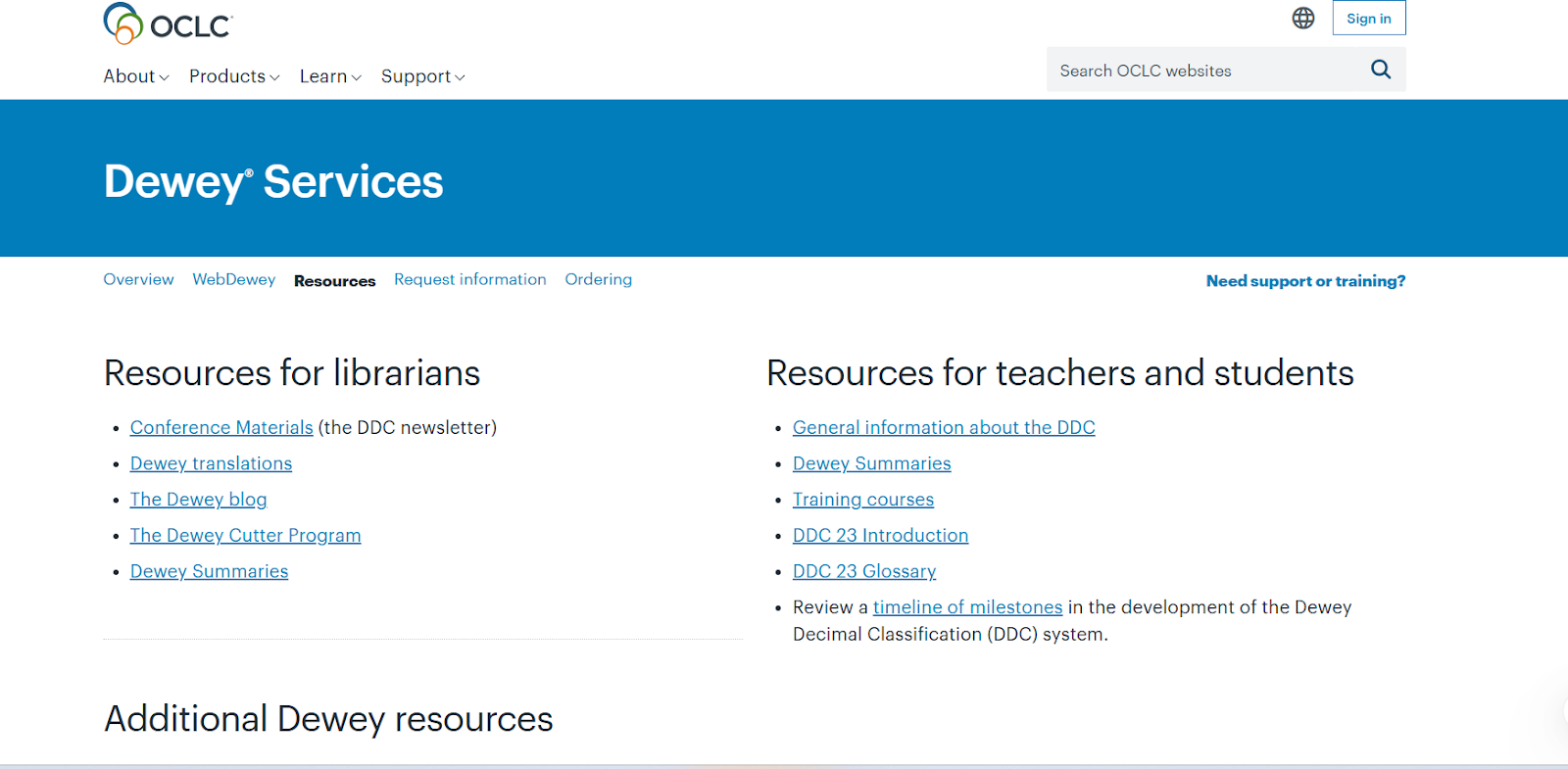
I visited the OCLC website (www.oclc.org/dewey/resources/tour) to take the online tour of the Dewey Decimal Classification (DDC) System. However, I did not find a section titled ‘Test Your Knowledge of DDC’. Instead, there is a DDC23 Introduction page available, which provides an overview of the history of the Dewey Decimal system and how it is used to organize library collections by assigning DDC numbers to specific subject areas.
👉 Click here to read more
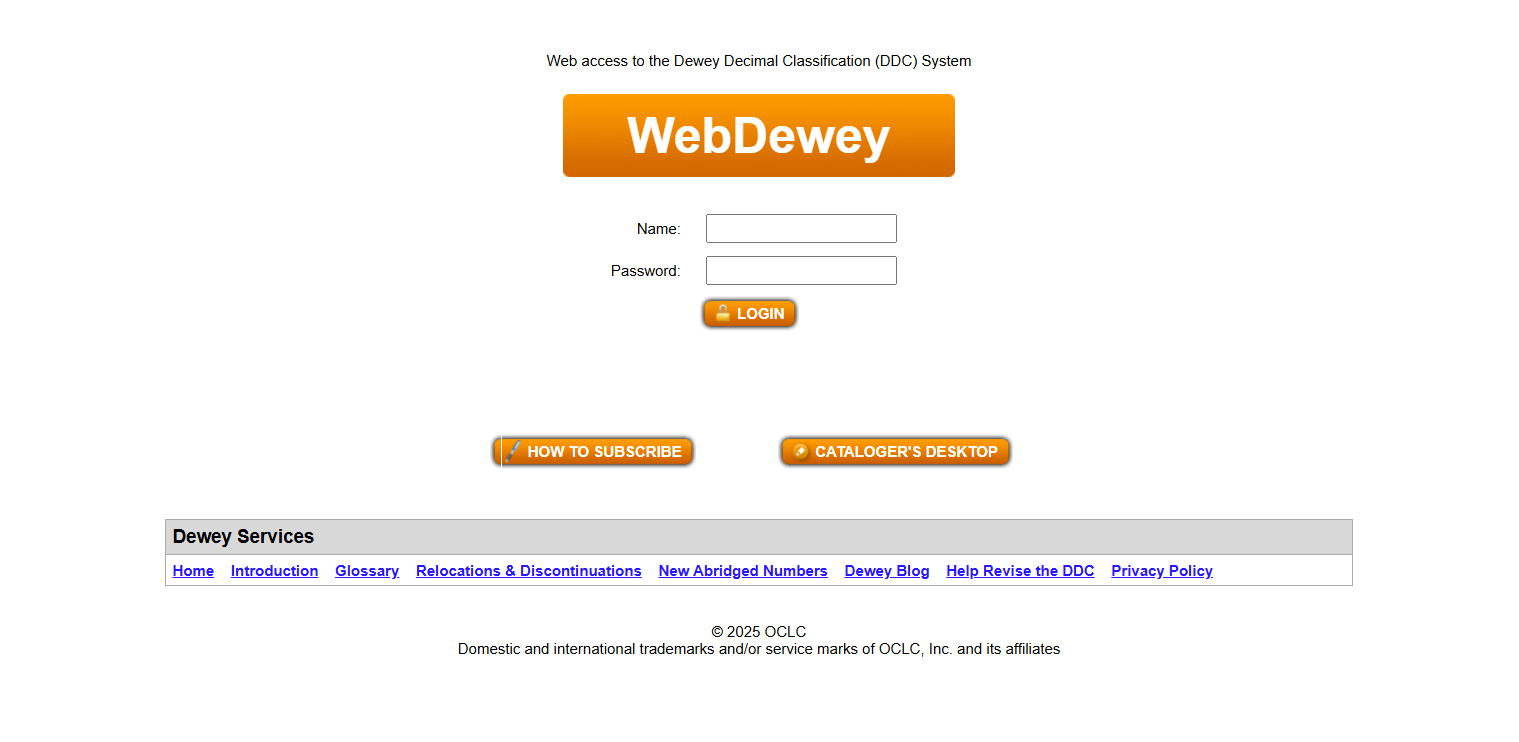
The DDC is published by OCLC, Inc., and access to the system is provided through WebDewey, a subscription-based, regularly updated online service. OCLC holds the copyright to the DDC and licenses its use.
WebDewey is primarily used by librarians and catalogers to assign subject classification numbers to materials. These numbers help in organizing and shelving library items systematically. It is especially valuable for subject cataloging in academic, public, and research libraries.
I was initially curious whether WebDewey and OPAC serve the same purpose. After researching on Google and asking ChatGPT, I found out that:
WebDewey is used behind the scenes by catalogers to classify books.
These classifications are entered into ILS/LMS (Integrated Library System/Library Management System) software.
The OPAC (Online Public Access Catalog) retrieves this information from the ILS and displays it to users, allowing them to search for materials by title, author, subject, and location.
While the DDC is widely used, there are other classification systems available. One notable alternative is the Library of Congress Classification (LCC), which is especially popular in academic and research libraries in the United States. LCC is freely available and offers a robust structure for organizing complex subject areas.
Q2.Using the University of London’s Senate House Library online catalogue (www.ull.ac.uk) as your reference, conduct a class- mark search for Dewey decimal number
655.45. What is the specialist subject that this class mark brings up, and where are
these books physically located inside Senate House Library?
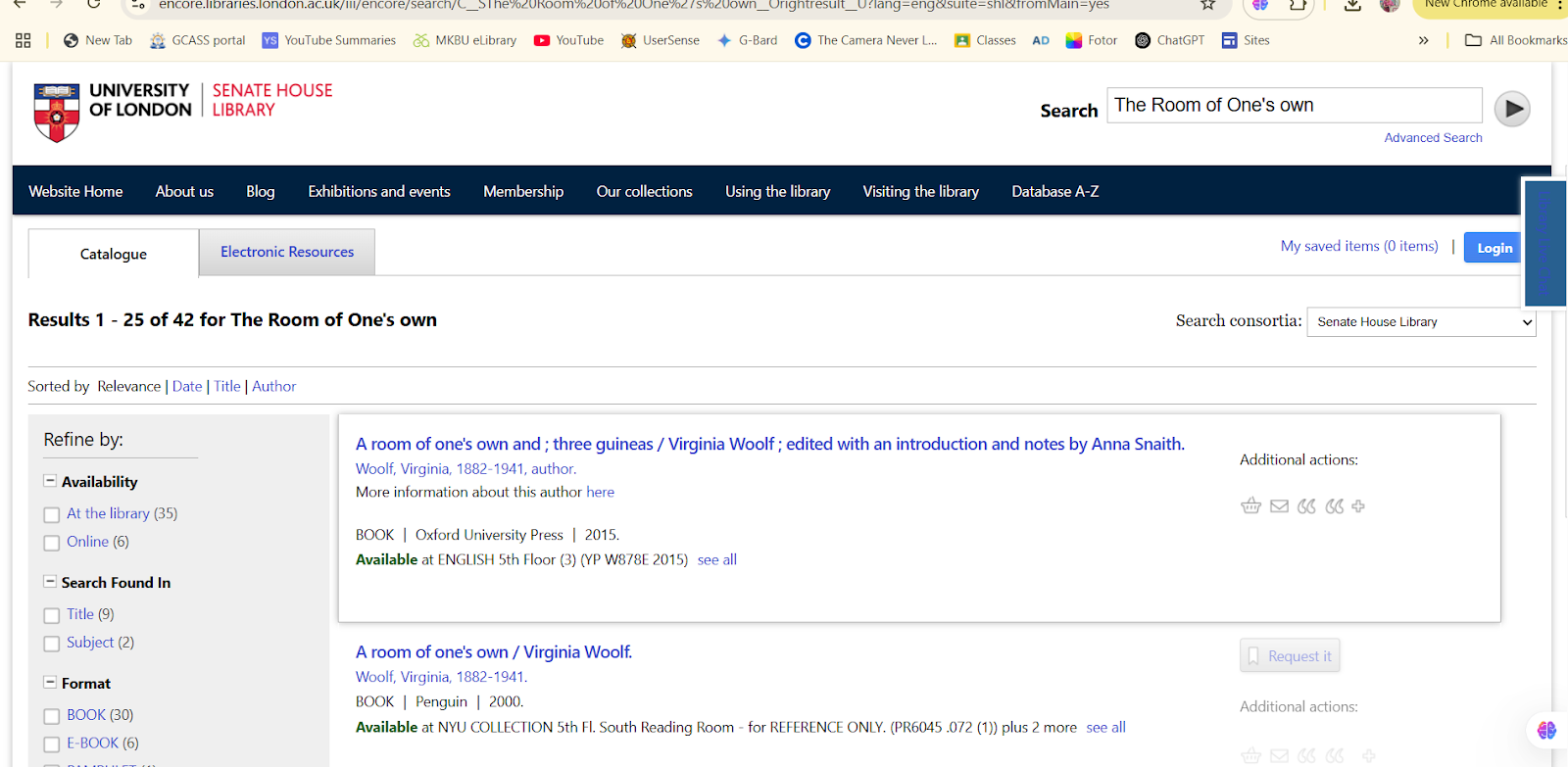
The site is given is not working. I searched 'University of London’s Senate House Library online catalogue'. Click here
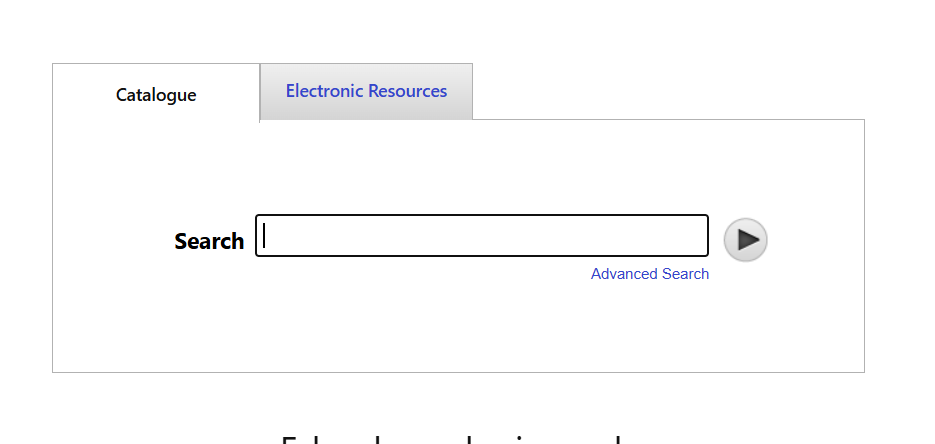
Scrolling down to the website, there is the page link of Search the catalogue, where one can search Catalogue and Electronic Resources.
I first searched for the number given 566.45, There was no result. But then I searched The Room of One's Own and the result was there. containing the book details and also the location of the book within the library.
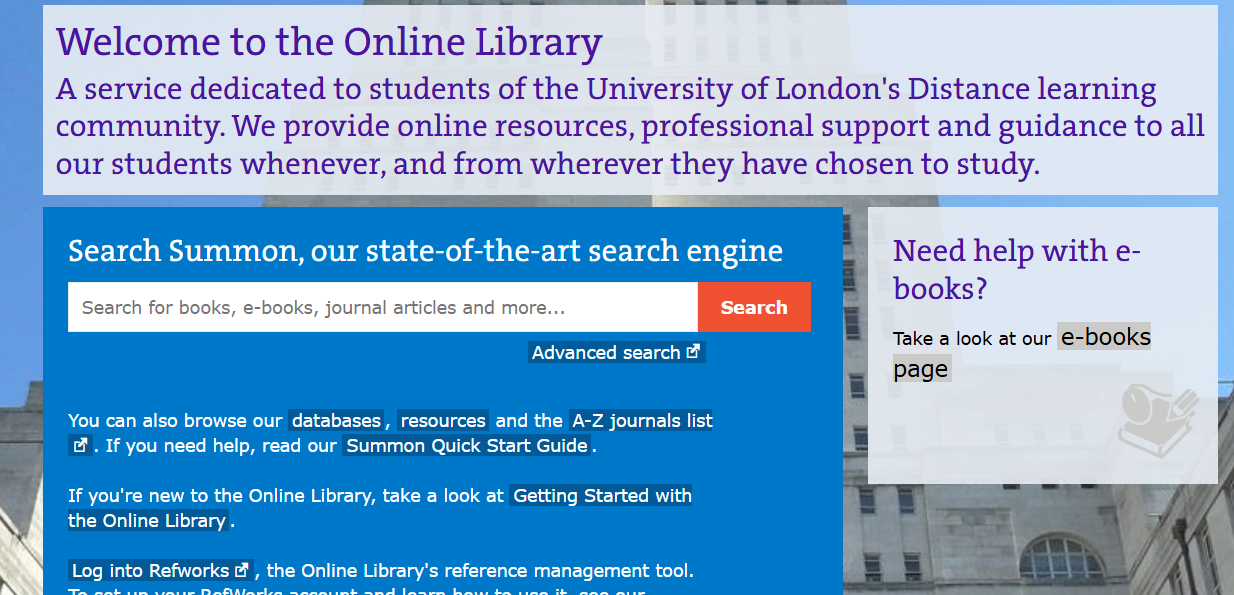
There was also other option available on University of London Senate House Library's Home page Named 'Using the Library'
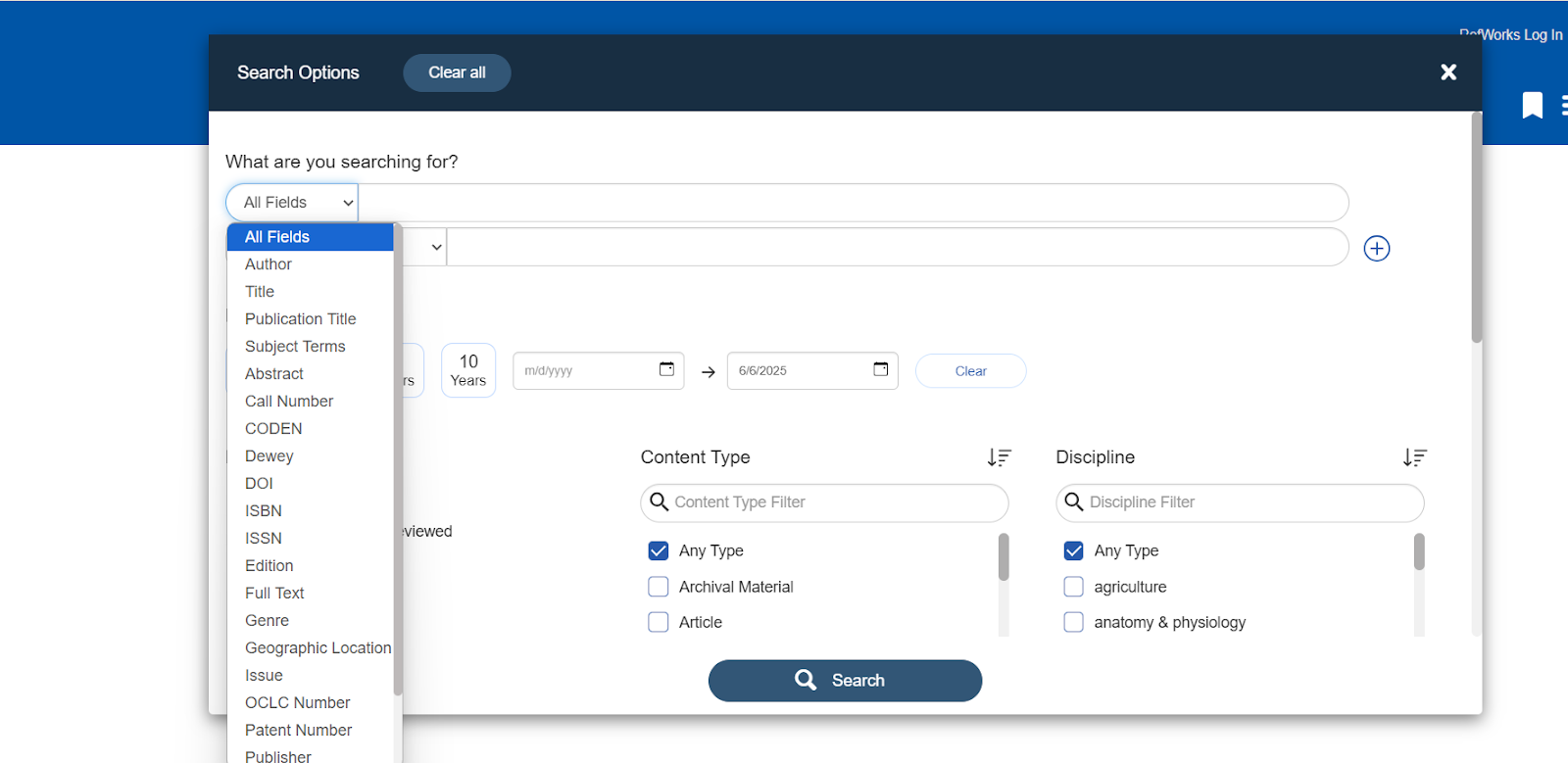
While Clicking on it, On the page there the option of Online Library, and then clicking on 'Visit Online Library', it has the option 'Advanced Search' Page.
On Advance search page, one can access the the resouces through various identification like title, author name, DD number, Abstract, OCLC number, Genre, Publisher, etc.
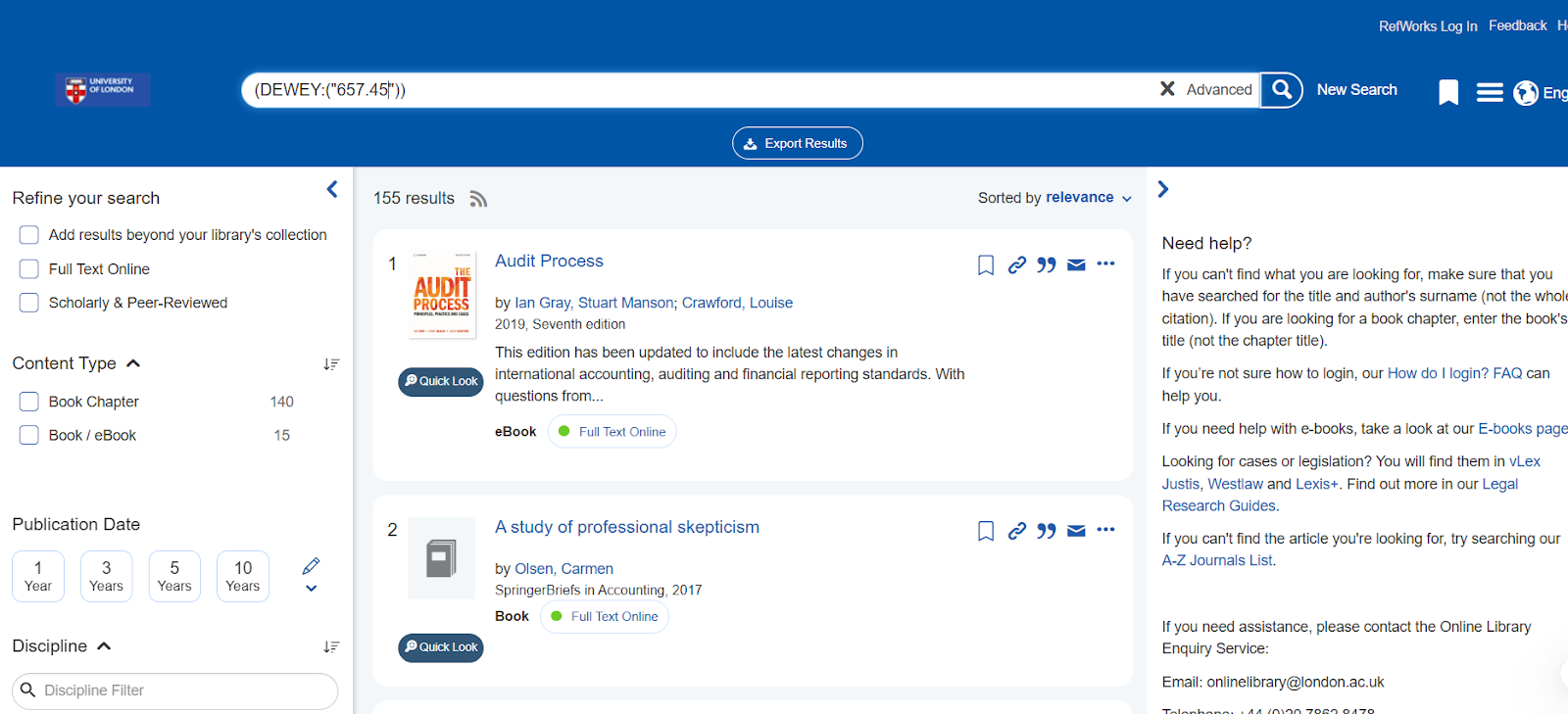
I searched the given number 655.45, but there was nothing available. Then I tried another number 657.45 and got the results of Books related to Audits.
Some book or resources full texts are available online but it can be only accessed by the members or thpose who have OpenAthens Acoount. One interesting point is that one can export the search results by only enering email to be sent on. This I found really interesting as the resources in bulk canbe exported in Excel/Sheet formate, a very helpful data for the researcher including all the necessary information like Title, Author, Publication, Volume, issue, etc,.
In the video, Kalyan Chattopadhyay sheds light on the essential features of academic writing. Critical writing differs significantly from creative and other forms of writing. What sets it apart is its objective tone, the frequent use of passive voice, and the strategic application of language markers. Academic writing typically follows a structured approach: it begins with a topical sentence, which is then supported by well-reasoned arguments. These arguments lead to a conclusion that does not simply repeat the topical sentence but rather reflects a critical engagement with it. As Professor Chattopadhyay emphasizes, merely restating the topical sentence in the conclusion weakens the overall quality of academic writing.
Another key aspect he discusses is the use of signaling expressions such as however, notwithstanding, and although. These expressions are vital for transitioning between ideas and introducing counterarguments or shifts in reasoning. For instance, in the context of my research on cartography, Reuschel highlights that spatial uncertainties arise when mapping literary texts due to the presence of imaginary locations. However, a deep analysis of the author’s descriptions can enable a cartographer to conceptualize and possibly locate these imagined places. In Gun Island, Amitav Ghosh mentions several fictional islands. Although these places do not exist in reality, a close reading of the geographical descriptions allows one to associate them with real locations within the Sundarbans.
The use of expressions like however and although helps in creating logical transitions and argument shifts. Yet, as Professor Chattopadhyay warns, the overuse of such expressions can make the writing unnecessarily complex and harder to follow. Therefore, they must be used judiciously.
Furthermore, posing questions is an essential component of academic writing. A researcher must attempt to answer these questions through supporting arguments. These are not limited to the main research questions posed at the beginning of the study, but also include questions that arise in response to existing scholarly arguments. Raising and addressing such questions allows the researcher to establish their own voice, which is crucial to the value and originality of any research work.
Video 2: Prof. Atanu Bhattacharya
In this video, Prof. Atanu Bhattacharya discusses the fundamentals of academic writing, covering key aspects such as what not to do, what can be done, the use of web tools, and a case study.
What Not to Do:
Professor Bhattacharya begins by referencing the well-known article Transgressing Boundaries: Towards a Transformative Hermeneutics of Quantum Gravity by Alan Sokal. He uses this example to critique the overuse of jargon in academic writing. Sokal’s article, written as a parody, strings together complex jargon and critical terms that make it nearly incomprehensible. His aim was to demonstrate that academic writing often prioritizes style over clarity, making it inaccessible. This highlights a key issue: if a piece of research cannot be understood by others due to excessive jargon, its value is greatly diminished. Professor Bhattacharya emphasizes that academic writing should not intimidate writers or readers—it should aim to communicate ideas effectively, not obscure them.
What Can Be Done:
To illustrate the ethical importance of academic writing, Bhattacharya refers to a case from Siddhartha Mukherjee’s The Emperor of All Maladies: A Biography of Cancer. He discusses a researcher whose research, a supposed cure for breast cancer, gained global attention, only to be later revealed as based on fabricated data and experiments. While academic and scientific fields may differ in methodology, both carry serious ethical responsibilities. Creating imaginary data or making unsupported claims can have grave consequences in any discipline.
To promote effective academic writing, Professor Bhattacharya offers several practical tips:
Write the introduction last, once the arguments are clearly developed.
Create an indexed literature review, documenting every resource encountered, even those not immediately useful—they may become relevant later.
Apply triangulation: consider multiple perspectives or methods when examining a research problem.
Avoid repeating arguments, as redundancy weakens the coherence and impact of the work.
Web Tools:
He encourages the use of digital tools for conducting a comprehensive literature review. Emphasis is placed on using high-quality sources such as those found in UGC Care List Journals and Scopus-indexed Journals.
For my own research literature review, I have been using various web tools such as ONOS, OpenAlex, Litmaps, Connected Papers, Semantic Scholar, Taylor and Francis Online, and JSTOR. These platforms have proven extremely useful in helping me find quality academic material and will continue to aid my research going forward.
Additionally, Professor Bhattacharya recommends tools that assist with language and writing clarity. Resources like Grammarly and AI-based platforms such as ChatGPT are valuable for refining the language and structure of academic texts.
He also addresses the critical issue of plagiarism, discussing its various forms and emphasizing the importance of originality and proper citation in research work.
Case Study:
In the final part of the video, Professor Bhattacharya discusses a case study, which I relate to my own research. My topic is The Digital Cartographic Study of Amitav Ghosh’s Novels. While exploring this field, I discovered that there is minimal existing scholarship directly related to this area. This lack of secondary material initially seemed like a barrier. However, as he suggests, such situations can be opportunities. In my case, it involves delving deeply into the broader field of cartography, understanding the historical evolution of mapping in fiction, reviewing recent discussions around digital cartography, and identifying tools and software for map-making. By connecting theoretical frameworks with practical mapping tools, I aim to contribute to this underexplored research area.
This approach exemplifies how a researcher can navigate limited secondary literature by broadening their inquiry and establishing a foundation through interdisciplinary study.
Video 3: The Mechanics of Writing- Atanu Bhattacharya
In this video, Prof. Atanu Bhattacharya discusses the Mechanics of Academic Writing, focusing on the importance of defining propositions, structuring research, and developing a critical voice.
He begins by emphasizing the role of formulating propositions and definitions in research. A researcher often needs to define key terms and concepts to support their arguments. Academic writing is not about stating absolute truths but exploring what might be true. Hence, phrases like "can be," "defined as," and "is often defined as" are useful in framing arguments.
Prof. Bhattacharya stresses that research should follow a clear structure: rationale, purpose, justification, literature review, methodology, arguments, and conclusion. While engaging with critics’ ideas, it is essential to paraphrase their views rather than directly quoting them, thereby avoiding plagiarism and building one’s own scholarly voice—what he refers to as “standing on the shoulders of giants.”
In the introduction, the rationale and a topical sentence (as suggested by Prof. Kalyan Chattopadhyay) should be clearly stated, followed by structured arguments and a well-developed conclusion.
Taking a stance is a critical aspect of academic writing. A researcher may agree, disagree, or partially agree with other scholars. Words like "generally," "apparently," and "arguably" help in expressing these nuanced positions. Hedging language, such as "seems," "appears," or "can be said," softens claims, acknowledging that the conclusions may not be definitive and other perspectives may exist.
Using the passive voice is also a strategy to hedge one’s stance and avoid sounding overly assertive.
Finally, Prof. Bhattacharya explains how to structure arguments within a research paper:
If the outcome supports the researcher’s claim, present the supporting arguments first, followed by analysis and reinforcement of how they uphold the main idea.
If the outcome challenges the researcher’s claim, it is crucial to first present and examine the existing supporting views, then offer critical evaluation, and finally introduce counterarguments with reasoning that supports the researcher's new position or modified stance.
This approach ensures that the research is balanced, analytical, and critically engaged with multiple viewpoints.
References:
DoE-MKBU, and Atanu Bhattacharya. Academic Writing: The Basics: Atanu Bhattacharya. 2020. YouTube, https://www.youtube.com/watch?v=jpVre1V6cxw.
DoE-MKBU, and Atanu Bhattacharya. Academic Writing: The Mechanics: Atanu Bhattacharya. 2020. YouTube, https://www.youtube.com/watch?v=AHCikaKKm48.
Academic writing stands apart from creative or informal writing due to its formal structure, objective tone, frequent use of passive voice, and strategic use of language markers. The passive voice should be used to objectify research writing.
Academic writing focuses on answering research questions with structured arguments, not just at the outset but throughout the work, especially in response to existing scholarship. This process enables researchers to establish their own voice and demonstrate originality.
Structure and Organisation
For strcturing and organising research Atanu sir mentions Swaler's CARS Model that includes, Definition, justification, literature review, methodology, arguments, and conclusion. He emphasizes the importance of paraphrasing critics’ views rather than quoting them directly to avoid plagiarism and to cultivate a personal academic voice—what he describes as “standing on the shoulders of giants.”
Academic writing adheres to a structured format—beginning with a topical sentence, followed by logical supporting arguments, and concluding with a statement that reflects critical insight. Signaling expressions such as however, although, and notwithstanding guide the reader through logical shifts. For instance, in my research on cartography:
“Reuschel highlights that spatial uncertainties arise when mapping literary texts due to the presence of imaginary locations. However, a deep analysis of the author’s descriptions can enable a cartographer to conceptualize and possibly locate these imagined places.”
Caution must be taken, however, to avoid overusing such expressions, as they may add unnecessary complexity.
Depending on whether research findings support or oppose a hypothesis, the structure of argumentation changes:
If supportive: present evidence first, followed by analysis and reinforcement.
If challenging: begin with prevailing opinions, critically evaluate them, and then introduce counterarguments with reasoning that aligns with the revised position.
Critical Writing
Critical writing entails thoughtful analysis, comparison, questioning existing viewpoints, and establishing one’s stance. A key component is posing and addressing questions—not only the primary research questions but also those arising from engagement with existing literature. This approach helps develop the writer’s critical voice and contributes to originality.
Taking a stance is a critical aspect of academic writing. A researcher may agree, disagree, or partially agree with other scholars. Words like "generally," "apparently," and "arguably" help in expressing these nuanced positions. Hedging language, such as "seems," "appears," or "can be said," softens claims, acknowledging that the conclusions may not be definitive and other perspectives may exist. For example, in Gun Island, associating fictional places with real locations in the Sundarbans, demonstrating how close reading enables analytical insight.
Literature Review and Justification
A literature review involves critically examining existing research. It is akin to standing on the shoulders of giants—building upon the foundational work of others to develop and support your own arguments. Effective research requires a thorough understanding of prior studies in the field, as well as a careful evaluation of the sources being cited.
For instance, Professor Bhattacharya references a case from The Emperor of All Maladies: A Biography of Cancer by Siddhartha Mukherjee. The book recounts the story of a researcher who claimed to have found a cure for breast cancer. His work received global acclaim, only for it to be later exposed as based on falsified data and fabricated experiments.
Although academic disciplines may differ in their methodologies, all fields share a commitment to ethical integrity. Fabricating data or making unsupported assertions undermines the credibility of research and can lead to serious consequences—both within the scholarly community and in the broader society.
Maintaining an indexed literature review is equally essential, even including sources that are ultimately unused. In reference to Atanu sir's Case study of lack of secondary material if i apply it in my research....
In my research on Amitav Ghosh’s novels, I initially found limited scholarship on digital cartography. Addressing this gap by broadening my review to include studies on mapping in fiction, the historical evolution of cartography, and digital mapping tools, his gap became an opportunity to make an original contribution by integrating theory with digital practices.
While conducting the literature review, I am accessing on academic databases and platforms such as UGC Care List Journals, Scopus-indexed Journals, ONOS, OpenAlex, Litmaps, Connected Papers, Semantic Scholar, Taylor and Francis Online, and JSTOR—tools that continue to support the depth and credibility of my research.
Research Methods
Prof. Atanu Bhattacharya also introduces triangulation—using multiple perspectives (data, method, theory) to approach a research problem. Additionally, ethical considerations in data usage and the role of passive voice and hedging in presenting nuanced arguments are highlighted. A structured approach to organizing arguments ensures logical flow and critical engagement.
Close reading/textual analysis:
Paraphrasing: engaging with scholarship while avoiding plagiarism
Use of passive voice and hedging: to maintain balance and avoid overassertion
Use of Digital tools: using platforms for citation mapping and literature analysis
These methods show how research blends qualitative analysis, ethical practice, and digital literacy.
Clarity and Accessibility:
Prof. Atanu Bhattacharya critiques the excessive use of jargon through the example of Sokal’s parody article, which mimicked academic writing filled with obscure terminology to expose its inaccessibility. This underscores the importance of clarity—academic writing should not alienate readers but aim to communicate ideas effectively. Research loses value if it cannot be understood due to complex language. Hence, accessibility and simplicity are key to meaningful scholarship.
Accessing quality resources is equally essential, what make the research stronger. The platforms like JSTOR, Taylor and Francis,
ONOS provide quality research resources to refer.
Key Learnings and Application
Avoiding jargon
Questioning the critical arguments and establishing the scholarly voice
Creating an indexed literature review
Keeping track of findings
Employing triangulation
Preventing repetitive argumentation
Using web tools
Maintaining ethical standards and originality
In my research on digital cartography in Amitav Ghosh’s novels, I have been applying these principles by:
Exploring broader discussions on mapping in fiction
Identifying tools and software for map-making
Merging theoretical insights with digital tools to contribute to an underexplored academic area
References:
DoE-MKBU, and Atanu Bhattacharya. Academic Writing: The Basics: Atanu Bhattacharya. 2020. YouTube, https://www.youtube.com/watch?v=jpVre1V6cxw.
DoE-MKBU, and Atanu Bhattacharya. Academic Writing: The Mechanics: Atanu Bhattacharya. 2020. YouTube, https://www.youtube.com/watch?v=AHCikaKKm48.
I have explored Digital research tools like OpenAlex, Connected Papers, and LitMaps that has played a pivotal role in supporting rigorous academic research by streamlining literature discovery, mapping scholarly networks, and uncovering overlooked yet relevant studies.
OpenAlex, with its extensive open-source metadata database, provides a comprehensive and transparent foundation for exploring academic literature across disciplines. Its ability to reveal connections between authors, institutions, and concepts helps researchers situate their work within broader scholarly conversations. Connected Papers offers a visual, node-based map that contextualizes a research topic by linking it to prior and derivative works. This approach is especially useful for identifying foundational texts and recognizing peripheral studies that might not emerge in a traditional keyword-based search. LitMaps, meanwhile, excels in monitoring and visually organizing literature over time, enabling users to track evolving research trends and relationships between articles. Its intuitive timeline and tagging functions make it particularly valuable for managing long-term research projects where keeping updated is essential.
So far, I have extensively used OpenAlex and found it immensely valuable, particularly for tracing academic networks and citation patterns. Going forward, I will continue using OpenAlex while integrating Connected Papers and LitMaps into my workflow. Among the three, LitMaps stands out for its ability to support dynamic, evolving research projects like mine, which explore literary cartography, digital spatial theory, and geovisualization. Its clear visualizations and ability to track developments over time make it an ideal companion for organizing and expanding literature reviews.
These tools significantly help in reducing bias and broadening the scope of a literature review. Traditional research often leans heavily on known journals, familiar authors, and established canons, potentially reinforcing disciplinary silos or Western-centric perspectives. Digital tools introduce algorithmic suggestions and network-based recommendations that encourage discovery beyond one’s usual reading lists. They can expose the user to lesser-known publications, emerging voices, and interdisciplinary overlaps—thereby countering selection bias. Moreover, OpenAlex’s openness and inclusivity, LitMaps’ dynamic visualization, and Connected Papers’ graph-based logic collectively offer diverse entry points into academic knowledge systems. When used thoughtfully, these tools not only support more inclusive and systematic research but also align with critical methods by questioning dominant narratives and highlighting underrepresented areas—such as the noticeable absence of Indian literary cartographies in current research.
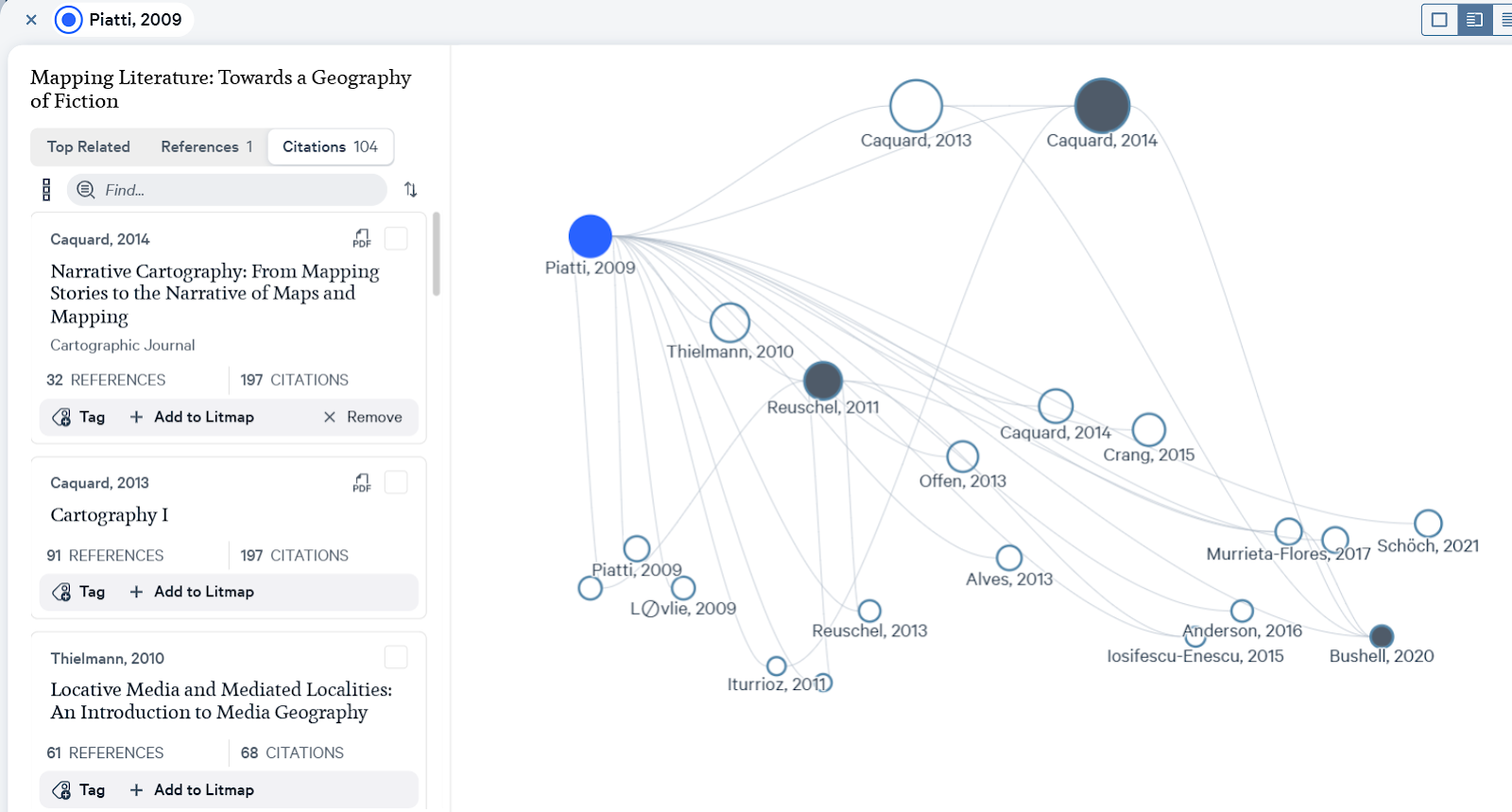
While exploring the forward and backword citation of the article Narrative Cartography: From Mapping Stories to the Narrative of the Maps and mapping, there are common patterns and school of thoughts have emerged inluding the articles, papers and books od areas like, Digital huamnities, Digital Cartography, Spatial Thepries, Literary Cartographies, Mapping tools like GIS, Historical geography Geosparial Visualisation. Additionaly while looking the the forward citations Cartograohies of other fields like cinema, Land, Digital Literature,Memory Studies, Keeping trace of history are found.
Most Frequently Appearing Authors
These authors consistently contribute to or are cited within the fields of cartography, literary geography, and spatial humanities:
Author
Notability / Area
David Cooper
Literary geographies; co-editor of Literary Mapping in the Digital Age
Pablo Iván Azócar Fernández
Research in critical cartography and geovisualization
Barbara Piatti
Pioneer in literary cartography; Atlas of Fictional Worlds
Sébastien Caquard
Narrative cartography; cartographic cinema
Rob Kitchin
Theoretical cartography, critical GIS, and geospatial epistemology
Robert E. Roth
Cartographic design, user experience in geovisualization
C. Fish
Works on spatial humanities and geocriticism
📚 Most Frequently Referenced Journals
These journals are dominant platforms for publishing and citing research on mapping, spatial theory, and geoinformation:
Journal Title
Focus Area
The Cartographic Journal
Core journal for cartographic theory and practice
International Journal of Geo-Information
Focuses on spatial data infrastructure and geoinformation science
Cartographia
Scholarly work on cartography and geospatial science
International Journal of Geographic Information Science
Advanced GIS theory and methods
Journal of Maps
Peer-reviewed cartographic outputs; includes fictional/spatial mapping
Cartographic Perspectives
Research and visualizations in contemporary mapping practice
Cartographics: The International Journal for Geographic Information and Geovisualization
Research on geovisualization, interface design, and spatial cognition
⮞Are there any surprising gaps or contradictions?
There is a significant body of research encompassing Digital Humanities, Digital Cartography, Spatial Theories, Literary Cartographies, mapping tools like GIS, Historical Geography, and Geospatial Visualization. While much of the scholarship engages with historical and general cartography, a notable gap emerges in the context of literary cartography. The most surprising observation is that although several cartographic studies focus on Western fictional works, there appears to be a complete absence of similar cartographic explorations of Indian literature.
Throughout my literature review, OpenAlex has been instrumental in helping me identify essential papers, books, and journals relevant to my research.
⮞ What is the main function or strength of this tool?
OpenAlex is a comprehensive, open-access scholarly database designed to facilitate structured research exploration. It provides detailed metadata on academic works, authors, institutions, journals, and topics. With its open-source model and rich API, it supports both individual research and large-scale bibliometric analysis, making it an excellent alternative to commercial databases like Scopus or Web of Science.
⮞ How user-friendly is the interface?
OpenAlex features a simple, accessible interface that supports effective scholarly exploration. Users can enter keywords to retrieve well-organized results, including titles, abstracts, author details, publication dates, sources, citation counts, and references. It also provides citation and reference data to contextualize a paper’s academic lineage. Additionally, the tool links to the full text when available and highlights open access resources. Its clean layout and organized structure make it an efficient platform for literature review.
⮞ What kind of outputs does it generate?
OpenAlex generates detailed, text-based outputs with comprehensive metadata. Each result includes:
Title, authors, and abstracts
Publication date and source journal
Citation and reference data
Subject classification and open access status
Links to full text, if available
Although it doesn’t offer visual graphs, its structured layout enables effective scholarly navigation and bibliometric analysis.
⮞ Did the tool help you discover any new or unexpected resources?
Absolutely. OpenAlex led me to foundational journals such as The Cartographic Journal and several Digital Humanities journals. These sources significantly enriched my research, offering new perspectives and anchoring my work in established scholarship within literary cartography and digital humanities.
⮞ What are its limitations?
OpenAlex, while robust, has a few limitations:
Lack of Visual Tools: It does not offer visualizations like citation graphs or thematic maps.
Dependent on External Sources: Full texts are not hosted; access depends on external platforms or open access availability.
Limited Filtering: The search interface has fewer advanced filtering options compared to specialized research databases.
No Personalization Features: It lacks options for saving searches, generating reading lists, or receiving recommendations.
Nonetheless, OpenAlex remains an invaluable, free resource for academic research and literature analysis.
LitMaps
⮞ What is the main function or strength of this tool?
LitMaps excels in visually organizing and tracking scholarly articles related to a specific keyword or research area. It automatically updates users with newly published papers relevant to their chosen topic, helping researchers stay current and identify thematic trends and scholarly connections.
⮞ How user-friendly is the interface?
The interface of LitMaps is highly intuitive and user-friendly. Users can easily search for academic articles using keywords or DOI numbers, and seamlessly generate visual citation maps. The tool supports the integration of multiple topics into a single map, allowing for the exploration of interconnections and thematic overlaps. Users can view references and citations for each article directly within the map, which aids in tracking the evolution of research. The platform also supports the discovery of recent publications, keeping researchers up-to-date with developments in their field.
⮞ What kind of outputs does it generate?
LitMaps produces interactive visual outputs that greatly enhance the literature review process:
Citation Trails: Display how one paper is cited by others, helping to trace academic influence.
Network Graphs: Show relationships between articles based on thematic and citation linkages.
Metadata Summaries: Include titles, authors, abstracts, publication dates, and citation counts.
Timeline View: Organizes papers chronologically, offering a temporal perspective of research evolution.
⮞ What keywords, DOI, or papers did you use to start your search?
I began with the foundational book Literary Mapping in the Digital Age, edited by David Cooper, which served as a springboard into the field of literary cartography.
⮞ Did the tool help you discover any new or unexpected resources?
Yes. Despite having already explored a significant portion of the literature, LitMaps revealed several new and unexpected articles relevant to my research on cartography. These works provided critical insights that aligned closely with my research objectives. Examples include:
LitMaps has a few notable limitations. The free version restricts users to only three maps. To create additional maps, users must delete existing ones or opt for a paid subscription. Additionally, the article import feature often fails to retrieve data, making it unreliable for incorporating external sources. The platform also doesn’t host full-text articles, providing access only if they are available through open access or external links.
Connected Papers
⮞ What is the main function or strength of this tool?
Connected Papers is designed to visualize the academic landscape around a specific research paper. By entering a title or DOI, it generates a graph based on citation relationships, showing both foundational and derivative works. This allows researchers to trace the development of ideas and discover influential papers they may not have otherwise encountered.
⮞ How user-friendly is the interface?
Connected Papers offers an exceptionally clean and easy-to-navigate interface. Its dual display modes—graph and list—cater to both visual and detailed analytical approaches. The graph view presents an interactive network of papers, color-coded by publication date (older papers in faded tones, newer in bold). The list view provides detailed information on each paper, including the title, authors, year of publication, citation count, and similarity to the original work. It also includes filters for access type (free PDFs, open access, code availability), and users can export the entire graph and list into Word format.
⮞ What kind of outputs does it generate?
Connected Papers produces several valuable outputs:
Visual Graphs: Show related works through thematic and citation-based links.
Citation Trails: Implicitly represented through connections between prior and derivative works.
List View: Includes detailed paper metadata and similarity scores.
Color-coded Timeline: Aids in tracking research development over time.
Exportable Data: Graphs and metadata can be downloaded for citation management.
⮞ What keywords, DOI, or papers did you use to start your search?
I started with Literary Mapping in the Digital Age, edited by David Cooper.
⮞ Did the tool help you discover any new or unexpected resources?
Yes, Connected Papers surfaced a range of related literature, expanding my awareness of the broader discourse in literary cartography.
⮞ What are its limitations?
While powerful, Connected Papers has its drawbacks. It does not provide access to full-text articles and draws heavily from Semantic Scholar, which may miss less-cited or niche journal articles—such as those from The Cartographic Journal. Additionally, it doesn’t show explicit citation chains (i.e., who cites whom directly), and lacks features for annotation or note-taking. Despite this, its graphical overview makes it an excellent tool for literature exploration.
Note: However, while exploring these web tools, it is often the case that full-text articles are not readily available on all platforms. In such instances, the complete resources can be accessed through databases like JSTOR, Taylor & Francis, and ONOS.





.png)